TOYOTA MOTOR CORP/ (TM)·Q3 2026 Earnings Summary
Toyota Names Finance Chief Kenta Kon as Next CEO; Sato Steps Aside After 3 Years
February 6, 2026 · by Fintool AI Agent
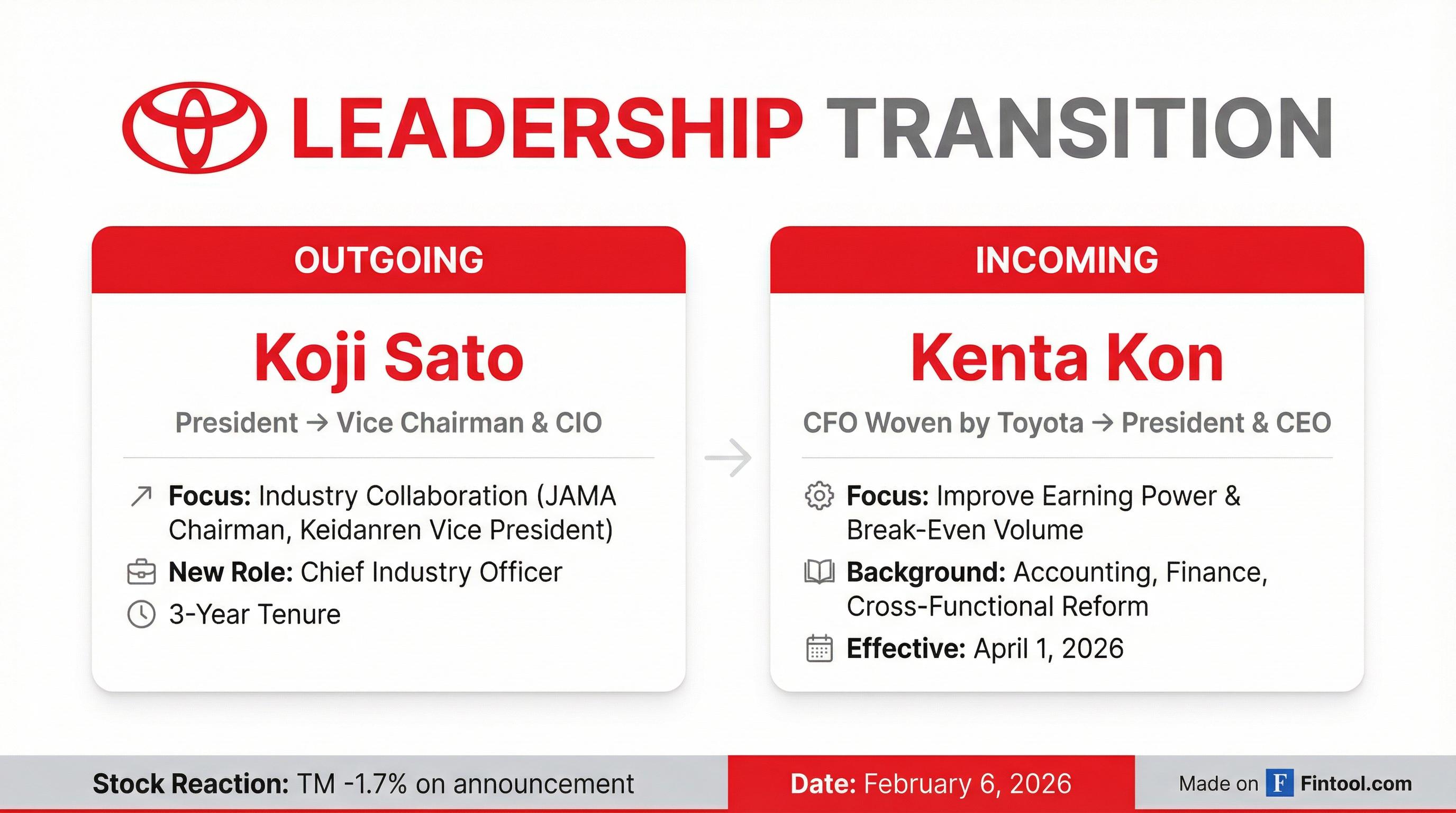
Toyota Motor Corporation announced a major leadership transition today, with President Koji Sato stepping aside after just three years to become Vice Chairman and Chief Industry Officer (CIO), while Kenta Kon, currently CFO of Woven by Toyota, will assume the role of President and CEO effective April 1, 2026. The surprise announcement came via a press conference rather than a traditional earnings call, with Toyota stock falling approximately 1.7% on the news.
Why Is Toyota Changing Leadership After Only 3 Years?
The leadership transition stems from a proposal by Toyota's executive appointment meeting, which recommended a "formation change" to address two key management challenges.
Challenge 1: Enhance Earning Power
Toyota acknowledged that after two years of "foundation strengthening efforts," the company now needs to shift gears toward improving productivity and creating "ever better, more affordable vehicles." Kon's finance background is seen as essential for this initiative.
Challenge 2: Accelerate Industry Collaboration
Sato's new role as CIO will allow him to focus full-time on industry-wide initiatives. He will serve as Chairman of JAMA (Japan Automobile Manufacturers Association) and Vice President of Keidanren, working to unite Japan's auto industry and maintain international competitiveness.
"For Toyota, more than before, the role that Toyota should play within the industry is becoming larger and more important than ever." — Koji Sato, Outgoing President
 Ask Fintool AI Agent
Who Is Kenta Kon?
Kon brings a distinctly different background to Toyota's top role compared to his engineering-focused predecessors:
Kon's experience at Woven by Toyota—a software development subsidiary with an "agile development culture"—gave him an outside perspective on Toyota's strengths and weaknesses. He noted that Toyota employees work "very hard with a strong mission" but tend to be "bound by past precedents" when pursuing new challenges.
When asked about Toyota's unique qualities, Kon referenced Chairman Akio Toyoda's comparison to Taizo Ishida—the legendary finance chief who served as "consigliere" to founder Kiichiro Toyoda. Like Ishida, Kon emphasized that money at Toyota should be used "with the warmth of humans" for the future of the company and its stakeholders.
What Will Kon Focus On?
Kon identified improving break-even volume as a key priority, acknowledging that this metric has been "increasing a little" over the past one or two years due to external factors and price levels.
"No matter how bad it becomes, no matter how tough the environment, we want to have a structure in place so that we can hang in there." — Kenta Kon, Incoming President
His approach will emphasize:
- Cross-functional awareness rather than siloed functional optimization
- Intentional pause to rebuild productivity foundations
- Creating an investment environment for autonomous driving and SDV development
On autonomous driving specifically, Kon acknowledged Toyota is not "advanced" compared to Tesla and Chinese players, but believes Toyota's 10 million annual sales and 150 million units in operation provide a "huge source of data" for catching up at speed.
How Did the Stock React?
Toyota shares fell 1.7% on the leadership announcement:
The stock had reached a 52-week high just one trading day before the announcement, potentially setting up a natural pullback that coincided with the surprise news.
Ask Fintool AI AgentWhat Is Sato's New Role?
Koji Sato will become Vice Chairman and Chief Industry Officer, a role designed to address Japan's automotive industry challenges from a broader perspective:
Notably, Sato will step down from Toyota's Board of Directors as of the June shareholder meeting. He explained this unusual move serves two purposes:
- Corporate governance compliance — Reducing board size and improving diversity
- Industry neutrality — Avoiding the perception of Toyota exerting "peer pressure" on other OEMs when advocating for industry-wide initiatives
"Unless we go through changes in the industry, then this auto industry that Japan has always been cherished as the critical industry will no longer serve its role." — Koji Sato
Financial Context: Toyota's Recent Performance
While today's announcement focused on leadership rather than quarterly results, Toyota's recent financial trajectory provides context for the "earning power" focus:
*Values retrieved from S&P Global
The declining margin trend—EBIT margin falling from 11.1% in Q1 2025 to 6.8% in Q2 2026—underscores why the incoming president's focus on "earning power" and "break-even volume" resonates with investors.
What Did Management Avoid Discussing?
The press conference focused heavily on governance rationale and leadership philosophy but provided limited detail on:
- Specific financial targets for margin improvement or break-even volume reduction
- Timeline for autonomous driving technology catch-up
- EV strategy evolution under new leadership
- China market challenges and competitive response
Key Quotes From the Announcement
On the transition timeline:
"When you think of the speed of the auto industry, it is not that lukewarm. In other words, the time frame in the past is completely different with this current three years." — Koji Sato
On no wrongdoing:
"Some of my friends text me and ask me if I did something bad. What did you do? So to avoid any misunderstanding, there is no wrongdoing." — Koji Sato
On Fun to Drive:
"I think the focus of Fun to drive is going to be more and more enhanced... Because from many angles, there will be many ways for people to get involved in making ever better cars." — Koji Sato
On Toyota's future:
"Is Toyota okay going forward? Yes, we are okay." — Kenta Kon
Ask Fintool AI AgentForward Catalysts
Bottom Line
Toyota's surprise leadership transition after just three years signals a strategic pivot from "ever better cars" philosophy toward hard-nosed financial discipline. Kon's mandate to improve earning power and reduce break-even volume reflects acknowledgment that margin compression has become a pressing concern. Meanwhile, Sato's elevation to an industry-wide role underscores Toyota's belief that Japan's auto sector requires collective action to remain globally competitive. The market's initial 1.7% selloff suggests investors are adopting a "wait and see" posture on whether a finance-focused CEO can maintain Toyota's product excellence while shoring up profitability.
Related: Toyota Company Profile | Q2 2026 Earnings | Transcript